.png)
Safety and Productivity: Why Choosing One Over the Other Is a False Choice


There is a belief that runs through a lot of organisations, sometimes spoken out loud and sometimes just quietly understood: that safety and productivity are pulling in opposite directions. That taking safety seriously means slowing things down. That compliance creates friction.
That somewhere in the gap between getting the job done and doing it safely, there is a trade-off to be made.
It is an understandable belief. Pressure to hit output targets is real. Deadlines exist. Resources are stretched. When a safety requirement feels like it is holding up the work, it is easy to frame it as a cost.
BUT the evidence does not support it!
And businesses that operate on that assumption tend to pay for it in ways that are far more costly than any short-term gain.
Where the Idea Comes From
The tension between safety and productivity is not new and it is not imagined. It is a genuine feature of the working environment in most industries.
Lord Cullen's inquiry into the Piper Alpha disaster in 1988 stated clearly that it is essential to create a corporate culture in which safety is understood and accepted as the number one priority. What the inquiry also found, implicitly, is that production pressure had been allowed to override that principle. 157 people died. The platform had continued operating under known hazards because stopping meant lost output.
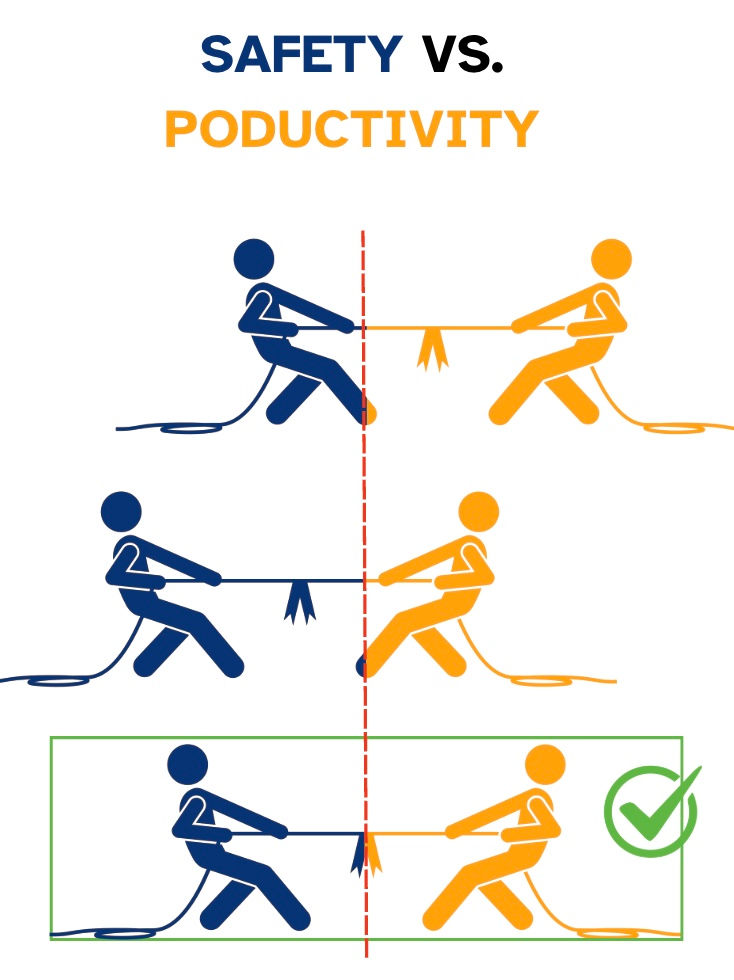
Dr Dominic Cooper, one of the most known researchers in the field of behavioural safety and safety culture, has written extensively on what he describes as the "safety-productivity conflict." His argument is not that the tension does not exist, it clearly does, but that framing it as a genuine conflict is the wrong way to think about it. The real question is not whether to prioritise safety or productivity, but how to manage both within the same system. He calls this approach "safe production," and the distinction matters.
The problem with the conflict framing is that it sets up a zero-sum choice. If safety wins, production loses. If production wins, safety loses. In practice, organisations that operate this way tend to end up losing on both counts.
What the Research Actually Shows
The body of evidence on the relationship between safety performance and business performance is now substantial and it points consistently in one direction.
Research published in the Journal of SHE Research found a statistically significant positive relationship between occupational safety and operating performance.
Organisations with stronger safety management tended to be more operationally effective, not less (Veltri et al., 2007).
Research referenced by the US Occupational Safety and Health Administration, based on a Liberty Mutual CFO survey, indicates that over 60% of financial leaders reported a return of at least 2$ for every 1$ invested in injury prevention, with productivity identified as the main benefit.
Research published in MIT Sloan Management Review found that businesses that have fully embraced worker safety tend to produce a higher quality product, have more productive and loyal workers, and experience fewer injuries, reducing the significant costs associated with them.
The systems required to make workplaces safer often also make processes more reliable, more consistent and better managed. Safety and operational excellence are not competing.
Where It Goes Wrong in Practice
If the evidence is that clear, why does the safety-productivity conflict persist as a working assumption in so many organisations?
Part of the answer is about short-term versus long-term thinking. System-dynamics modelling shows that short-term productivity gains from unsafe working practices tend to backfire through degraded worker capacity, increased human error and higher injury rates over time. In the short term, skipping a safety step or ignoring a risk might look like efficiency. In the medium term, it tends to produce exactly the kind of disruption, injury, investigation and lost capacity that destroys operational performance.
The other part of the answer is about how messages get transmitted through organisations. A director can sign a safety policy and mean every word of it. But if the supervisors on the ground are rewarded purely on output and never held to account for safety lapses, the workforce will quickly work out what actually matters.
This shows up in health and safety audits regularly. The documentation says one thing. The site tells a different story. Not because people are malicious, but because the incentive structures, the daily pressures and the informal norms point in a different direction to the formal policy.
The “Safe Production” Mindset
A better way to look at safety and productivity is not as two competing priorities, but as two parts of the same system. Good work should be planned, organised and delivered safely from the start, rather than treating safety as something that is checked only after an incident, delay or near miss.
Production targets should include safety performance.
When output is the only thing being measured, it naturally becomes the main thing people focus on. Including safety measures such as near miss reporting, audit findings, close-out actions and incident trends sends a clearer message about what the organisation values.
Risk assessments and method statements should be working tools, not paperwork exercises.
A RAMS document that sits in a folder and only appears when requested is not actively managing risk. Safe production means workers understand the controls, supervisors check that they are realistic and the system makes the safe way of working the easiest way to work.
Shortcuts need to be explored, not simply banned.
People often take shortcuts when a process feels awkward, unrealistic or disconnected from the pressures of the job. The better response is to ask why the shortcut is happening. Is the procedure practical? Are the controls suitable? Have the workers been involved in shaping the method? This helps fix the system, not just blame the individual.
Leadership behaviour sets the standard.

What leaders tolerate often matters more than what policies say. A supervisor who walks past unsafe work without comment sends a message. A supervisor who stops, has a calm conversation and asks what would make the task safer sends a very different one. That kind of leadership supports both safer work and better performance.
The Cost of Getting It Wrong
If the business case still feels abstract, the numbers make it concrete.
The HSE's most recent estimate puts the annual cost of workplace injury and work-related ill health to the British economy at over £20 billion.
Behind those figures are direct costs: compensation, treatment, investigation time, legal fees, regulatory enforcement... And indirect costs that are harder to quantify but often larger: project delays, lost expertise when skilled workers cannot return to work, reputational damage, the impact on the people who witnessed the incident and on the wider team.
Businesses that cut corners to save time and increase output can appear efficient in the short term. In the longer term, these environments become unsafe and increase downtime considerably.
What This Looks Like in Practice
For most UK businesses, particularly in construction, the safe production philosophy translates into a fairly practical set of questions. Such as:
Are risk assessments being done by people who actually know the work or are they produced to satisfy a procurement requirement and then filed away? Are the people on the ground involved in identifying hazards and developing controls or are documents handed down to them from above?
Are near misses being reported and acted on or are they quietly absorbed because reporting them feels like it will cause problems?
Is the health and safety policy a working document that reflects how the business actually operates or a piece of paper signed years ago that lives in a drawer?
None of these questions require significant investment. They require a shift in how safety is understood within the organisation: not as a regulatory burden sitting alongside the real work, but as a fundamental part of how the real work gets done well.


Comments