.png)
What is a Risk Assessment and Who Needs One? A Complete Guide for UK Businesses.

Updated: Mar 30
Every workplace has hazards, from slip risks to machinery dangers. Understanding what is a risk assessment and who needs one is a legal requirement that saves lives and protects your business. Whether you're a new manager, a small business owner or responsible for workplace safety, this guide explains everything about risk assessments in the UK.
All UK employers with employees must conduct risk assessments by law. If you have 5 or more employees, you must document significant findings. Risk assessments identify workplace hazards, evaluate risks and implement control measures to prevent accidents and stay compliant.

What is a Risk Assessment?
A risk assessment is a systematic process that identifies potential workplace hazards, evaluates the likelihood and severity of risks and determines suitable control measures to eliminate or minimise those risks.
The process examines your workplace activities, equipment and environment to answer three key questions:
What could go wrong?
How likely is it to happen?
What would be the consequences if it did?
Risk assessments are practical tools that create safer workplaces, protect employees and make sure your business meets its legal obligations under UK health and safety law.
Legal Requirements: The Foundation of Risk Assessment Law
UK risk assessment requirements stem from two key pieces of legislation that work together to create a comprehensive safety framework.
The Health and Safety at Work Act 1974 (HASAWA) is the primary piece of legislation covering occupational health and safety in the UK, establishing the foundation for all workplace safety regulations. The primary purpose of the Act is to prevent workplace accidents, injuries and illnesses by placing a legal duty on employers to assess and mitigate risks to health and safety.
HASAWA establishes the fundamental principle that employers must ensure, "so far as is reasonably practicable," the health, safety and welfare of their employees and anyone affected by their work activities. This includes conducting risk assessments to identify and control workplace hazards.
Under the Management of Health and Safety at Work Regulations 1999, the minimum you must do is: identify what could cause injury or illness in your business (hazards), decide how likely it is that someone could be harmed and how seriously (the risk) and take action to eliminate the hazard or if this isn't possible, control the risk.
These regulations specify exactly how employers must fulfill their HASAWA duties by requiring "suitable and sufficient" risk assessments.
Who Must Conduct Risk Assessments
All employers regardless of business size must carry out risk assessments, including:

Limited companies with employees
Sole traders with staff
Partnerships employing people
Public sector organisations
Charities with employees
Employers with five or more employees must record any significant findings of their risk assessment and any group of employees identified as being especially at risk. This documentation requirement ensures there's a clear record of identified hazards and control measures.
Self-Employed and Competent Person Requirements
Self-employed individuals must also conduct risk assessments if their work activities could affect others health and safety. Employers don't have to personally conduct risk assessments, they can nominate a competent person with the necessary knowledge, experience and skills to identify hazards and evaluate risks effectively.
The Five Steps to Risk Assessment
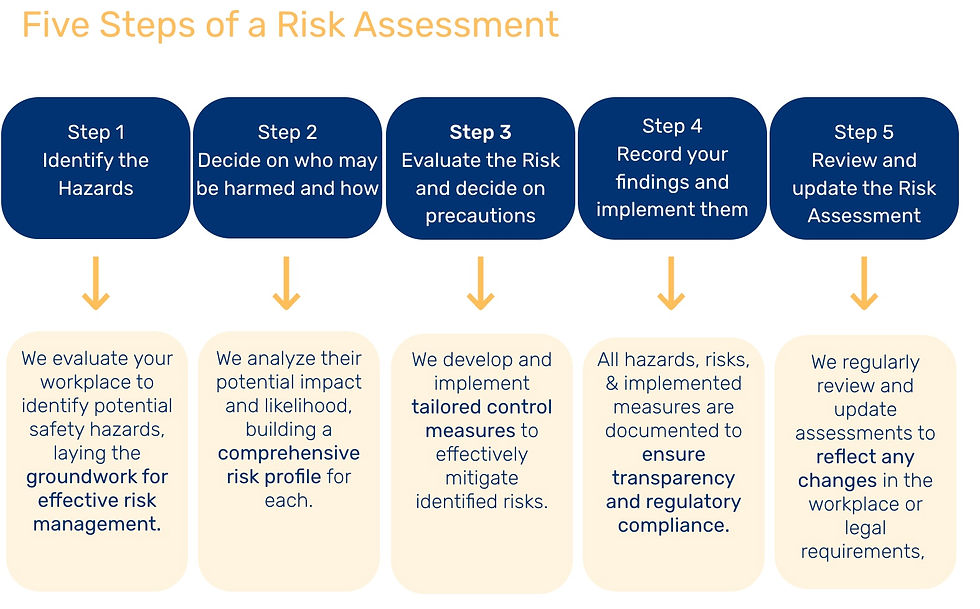
The HSE outlines a straightforward five-step process for conducting legally compliant risk assessments.
Step 1: Identify the Hazards
Systematically examine your workplace to identify anything that could potentially cause harm:
Physical hazards: Slippery floors, unguarded machinery, electrical equipment, working at height or moving vehicles.
Chemical hazards: Cleaning products, paint fumes, industrial chemicals, asbestos or solvents.
Biological hazards: Bacteria, viruses, contaminated materials or legionella.
Ergonomic hazards: Poor workstation setup, repetitive tasks, manual handling or awkward postures.
Psychosocial hazards: Work-related stress, violence, bullying, lone working or shift patterns.
Walk through your workplace, check accident records and consult employees who understand day-to-day risks.
Step 2: Decide Who Might Be Harmed and How
Consider all people who could be affected by identified hazards:
Employees (including part-time, temporary and agency staff).
Visitors and customers accessing your premises.
Contractors and delivery personnel working on-site.
Members of the public who might be affected by your work activities.
Vulnerable groups requiring special consideration: young workers under 18, pregnant employees, people with disabilities or new starters.
For each hazard, determine how different groups might be affected and whether some face higher risks.
Step 3: Evaluate the Risk and Decide on Precautions
Assess the likelihood and severity of potential harm for each hazard:
How likely is an incident to occur?
How severe could the consequences be?
How many people could be affected?
Apply the hierarchy of risk control:
Elimination: Remove the hazard completely where possible.
Substitution: Replace with something safer (less toxic chemicals, quieter machinery).
Engineering controls: Install safety barriers, ventilation systems or machine guards.
Administrative controls: Implement safe work procedures, training or job rotation.
Personal protective equipment (PPE): Last line of defence, when other controls aren't sufficient.

Step 4: Record Your Findings and Implement Them
Document your risk assessment findings:
All identified hazards and their potential consequences.
People at risk and how they might be harmed.
Risk evaluation and likelihood assessments.
Control measures implemented to manage each risk.
Responsible persons for implementing and monitoring controls.
Review dates to ensure assessments remain current.
Businesses with five or more employees must record significant findings and any groups identified as being especially at risk. Even smaller businesses benefit from written records for consistency and training.
Step 5: Review and Update the Risk Assessment
Risk assessments require regular review and updates when:
Significant changes occur to work activities or processes.
New equipment, substances or technologies are introduced.
After incidents, accidents or near misses occur.
New information about hazards becomes available.
At least annually as good practice or more frequently for high-risk activities.
Common Types of Risk Assessments
Different workplace activities require specific risk assessment approaches:
General Workplace Risk Assessments:
Cover overall workplace hazards including slip and trip risks, workplace transport, general equipment use and environmental factors like lighting and temperature.
Manual Handling Risk Assessments
Required wherever employees may risk injury through lifting, carrying, pushing or moving loads. Must consider load weight, individual capability, task frequency and environmental factors.
Display Screen Equipment (DSE) Risk Assessments
Required for employees using computers, laptops and display screens regularly. Address workstation setup, seating, lighting and break patterns to prevent musculoskeletal disorders.
COSHH Risk Assessments
Essential where hazardous substances are stored, used or manufactured. Control of Substances Hazardous to Health (COSHH) assessments evaluate chemical risks and implement appropriate control measures including ventilation, storage and emergency procedures.
Required under the Regulatory Reform (Fire Safety) Order 2005 for most non-domestic premises. Focus specifically on fire hazards, escape routes, detection systems and emergency evacuation procedures.
Required under the Management Regulations to assess work-related stress and mental health risks. These evaluate workload pressures, working relationships, organisational change, job demands and support systems to identify factors that could cause psychological harm and implement appropriate controls.
Why Risk Assessments Matter for Your Business
Legal Protection and Compliance
Risk assessments demonstrate legal compliance and due diligence under HASAWA and the Management Regulations. HSE enforcements shows companies can face substantial fines. Proper risk assessments help avoid such enforcement action.
Employee Safety and Workplace Culture
Accident rates are lower where employees genuinely feel they have a say in health and safety matters, compared with workplaces where employees don't get involved. Effective risk management prevents workplace injuries and creates a culture where safety is everyone's responsibility.
Financial Benefits
Preventing accidents saves money through:
Reduced insurance premiums and lower claims.
Decreased sick leave costs and compensation claims.
Improved productivity from a healthier workforce.
Avoided HSE fines, legal costs and business disruption.
Better staff retention and reduced recruitment costs.
Business Reputation and Competitive Advantage
Demonstrating commitment to employee safety enhances your reputation with customers, suppliers and potential employees. It positions you as a responsible employer and can provide competitive advantages in tendering and recruitment.
Practical Steps for Getting Started
Assess Your Current Position

Review existing risk assessments to check if they're current and cover all significant workplace activities. Identify gaps where assessments are missing or outdated.
Prioritise High-Risk Activities
Focus first on activities most likely to cause serious harm:
Work at height or in confined spaces.
Use of hazardous substances or machinery.
Manual handling of heavy or awkward items.
Activities involving lone working or public interaction.
Involve Your Team
Workplaces with health and safety committees where some members are selected by unions have significantly lower work-related injury rates than workplaces without cooperative health and safety management.
Engage employees throughout the risk assessment process, they understand day-to-day risks and can suggest practical solutions. This involvement improves both assessment quality and employee buy-in to safety measures.
Use Available Resources
The HSE provides risk assessment templates and example assessments to help businesses get started. However, you cannot simply copy an example and add your company name, each assessment must be specific to your workplace.
Templates provide useful starting points, but your assessments must reflect your specific hazards, workforce and working methods.
When Professional Support Makes Sense
Many businesses benefit from professional health and safety support, particularly when:
Facing complex or high-risk activities requiring specialist knowledge.
Lacking internal health and safety expertise or resources.
Operating in specialised industries with specific regulatory requirements.
Dealing with HSE inspections or enforcement action.
Implementing significant changes to processes, equipment or premises.
Professional consultants can act as your competent person under the Management Regulations, providing expertise in risk assessment, legal compliance and practical safety solutions. They bring experience from different industries and stay current with changing regulations and best practices.
At DuoDynamic Safety Solutions, we specialise in comprehensive risk assessment services tailored to your business needs. We work alongside your team to identify risks, develop practical control measures and ensure full legal compliance. We can act as your competent health and safety person, providing ongoing support to maintain and improve your workplace safety standards.
Conclusion
Risk assessments are fundamental to workplace safety and legal compliance in the UK. The Health and Safety at Work Act 1974 and Management of Health and Safety at Work Regulations 1999 require all employers to conduct suitable and sufficient risk assessments, with documented findings required for businesses with five or more employees.
The five-step process provides a systematic approach to identifying hazards, determining who could be harmed, evaluating risks, implementing controls and maintaining current assessments. Effective risk assessments prevent accidents, protect employees and safeguard businesses from legal and financial consequences.
While the process may seem challenging initially, breaking it into manageable steps and seeking professional support when needed makes it achievable for businesses of all sizes. The investment in proper risk assessment pays dividends through reduced accidents, lower costs and improved workplace culture.
Ready to ensure your workplace is safe and legally compliant? Contact DuoDynamic Safety Solutions today for risk assessment services tailored to your business needs.


Comments